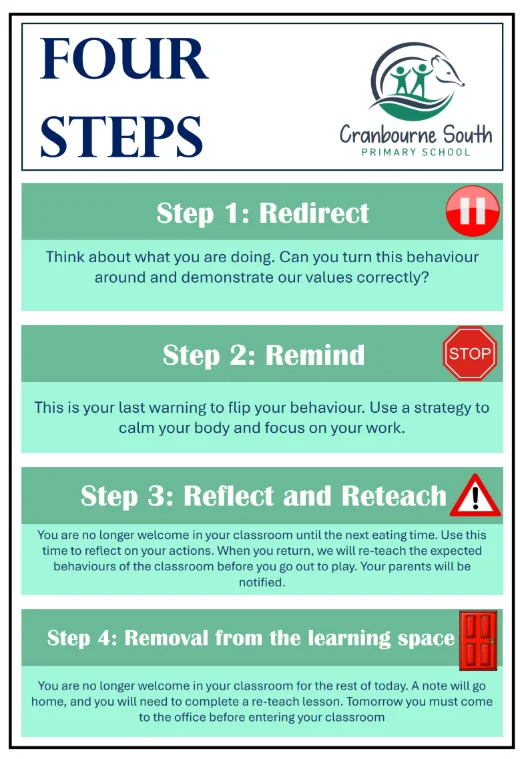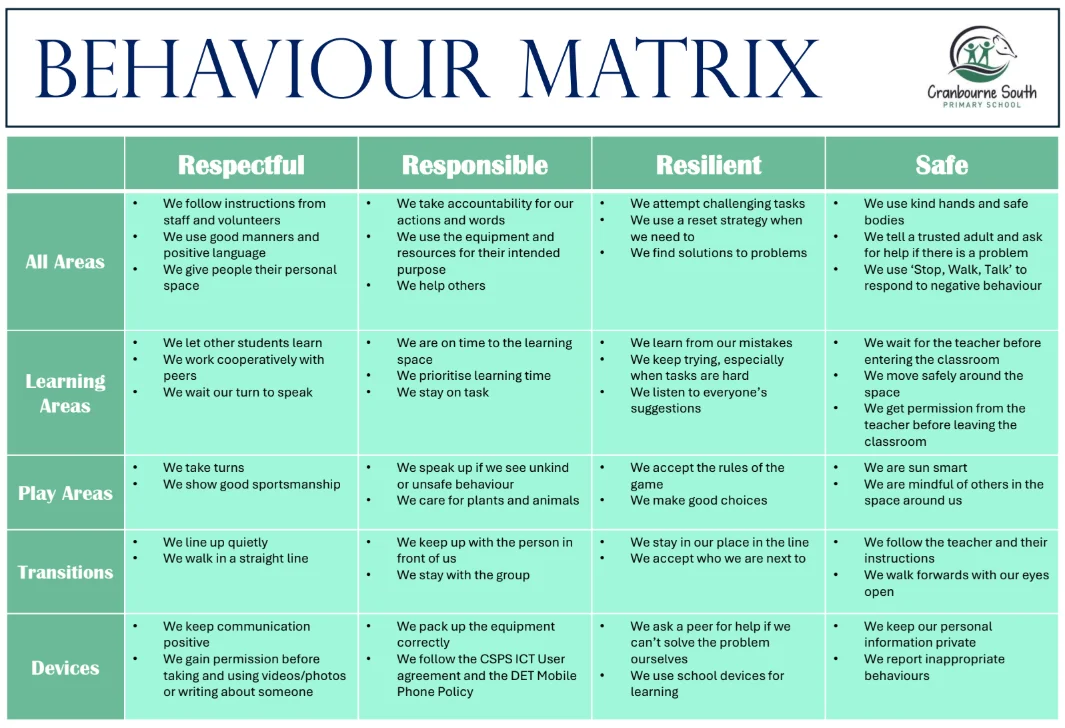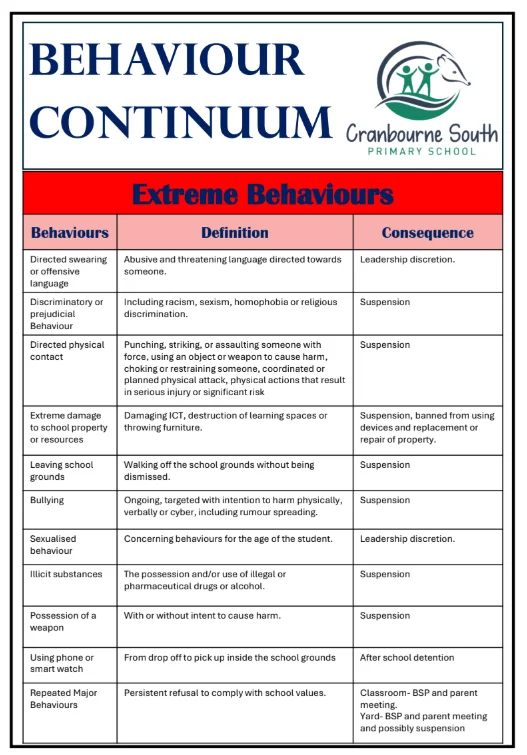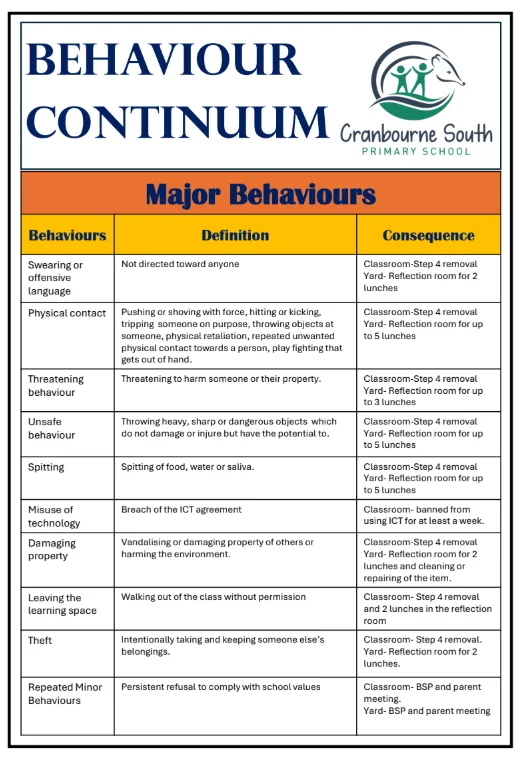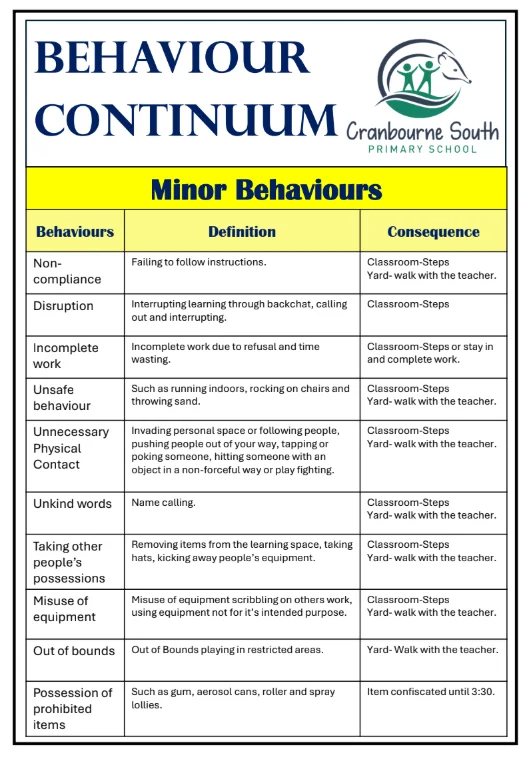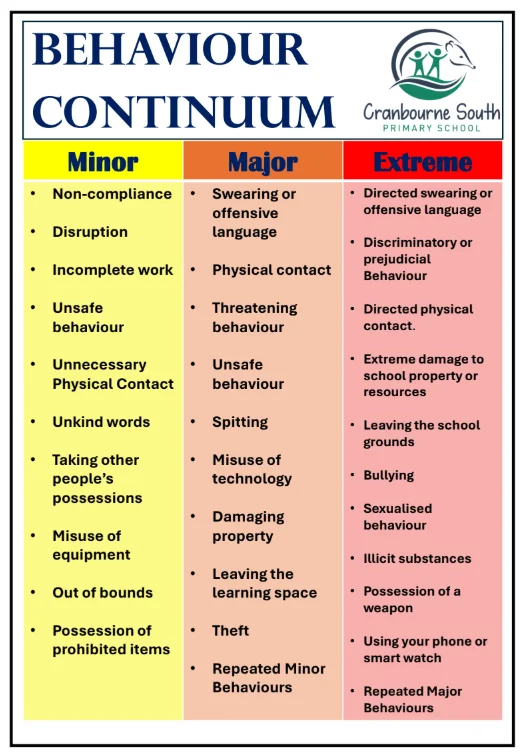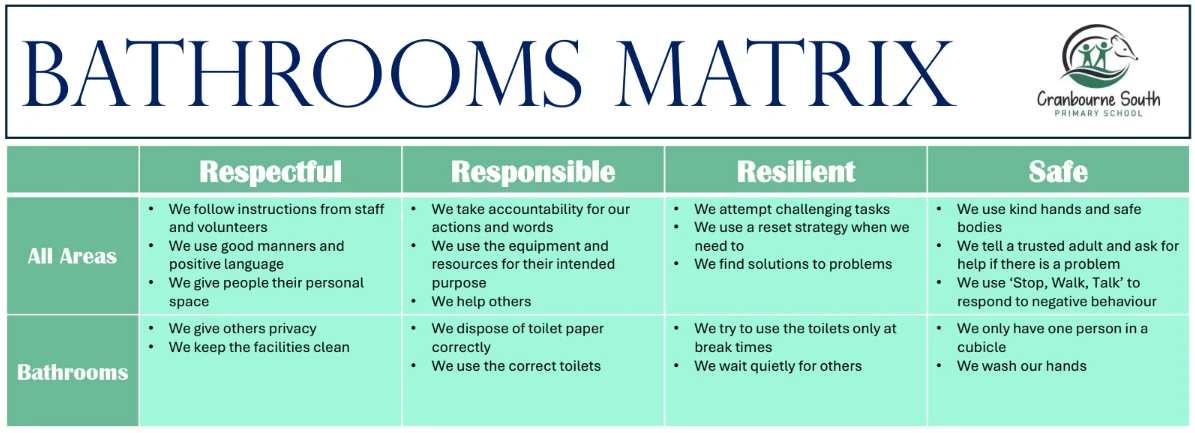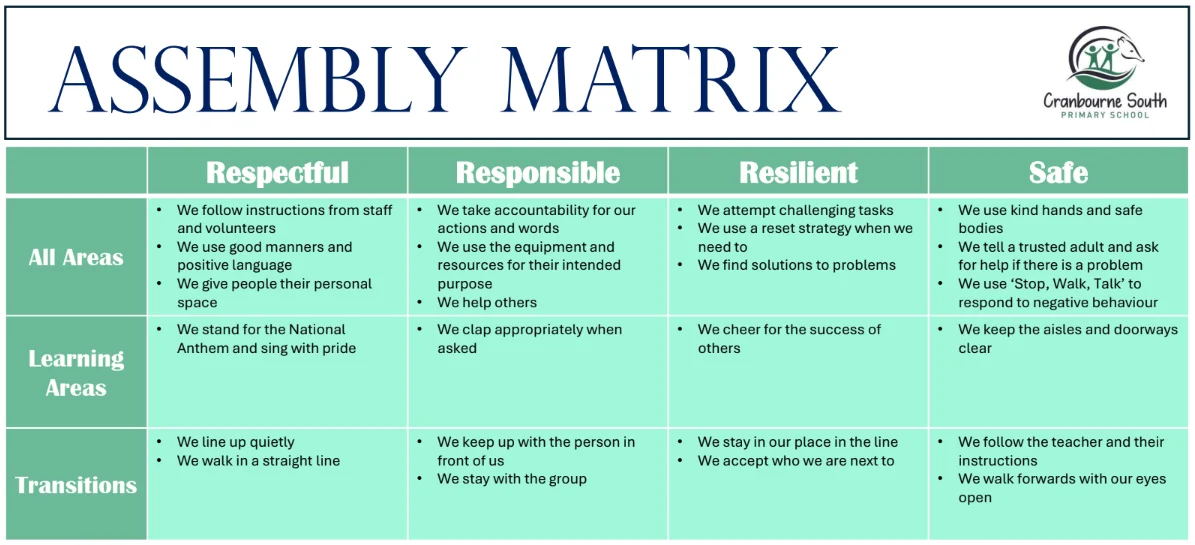
The goal of School Wide Positive Behaviour Support (SWPBS) at Cranbourne South Primary School is to create and maintain a positive and safe learning environment that enhances our school culture where we maximise individual academic and social growth.
The SWPBS approach consists of evidence-based behavioural interventions and practices that can be implemented by staff to effectively address and support the socially and educationally important behavioural needs of students and their families.
Our Lunchtime Clubs are built around what our students love. From art and gardening to chess, puzzles, and active games, our lunchtime lineup changes across the year, each term, to keep things exciting. Supervised by staff (and supported by our student leaders), clubs provide a safe, supportive space for students to share their interests and belong. Many of these clubs are led by our school Student Leaders with the supervision of a teacher.


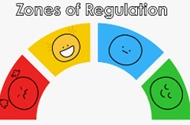
Cranbourne South Primary School practices and utilises the Zones of Regulation to support children to manage difficult emotions, known as ‘self-regulation’. We want to teach all of our children good coping and regulation strategies so they can help themselves when they experience anxiety and stress. In the classroom, sometimes children panic when faced with a tricky learning problem or challenge. By teaching them how to cope with these feelings might make them better at tackling learning challenges and build better resilience so they don’t give up so easily when faced with difficulty.
We aim to help children to:
Our school sensory room is a calm, flexible environment tailored to meet the diverse sensory processing needs of all students—including neurodivergent children and those with autism or ADHD. It provides a quiet retreat when the classroom or playground feels overwhelming.

The space can be used in a variety of ways:
At Cranbourne South PS, we believe that learning extends far beyond the classroom walls. We are thrilled to welcome our students to our Sensory Playground – an inclusive, multi-sensory outdoor environment where children of all abilities can connect, discover, and thrive.
This specialised space has been intentionally engineered to stimulate the seven primary senses, encouraging inclusive play. By blending nature-based play with structured tactile elements, our sensory playground helps students regulate sensory input, build motor skills, and foster meaningful social connections in a safe, engaging environment.
This evolving playground includes tactile and nature exploration (touch and sight), balance and body awareness and a variety of equipment to promote fine and gross skills.
How do we build and maintain healthy relationships in schools?
The most profound learning occurs when there is a healthy relationship between teacher and student. Restorative Practices assists teachers, students and parents to build, maintain and restore relationships. Restorative Practices will help build capacity to enable students to self regulate behaviour and contributes to the improvement of learning outcomes.
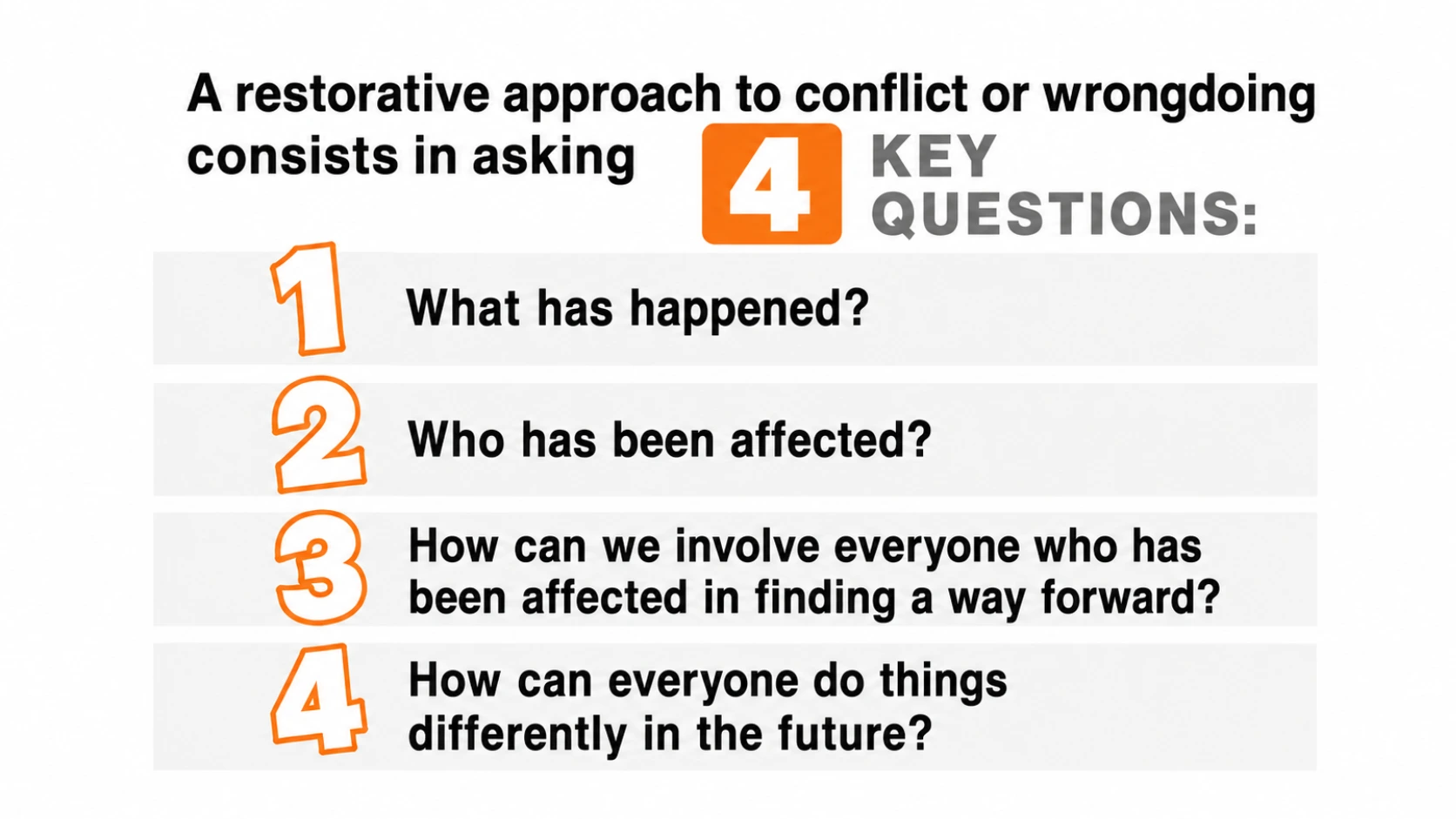
Cranbourne South Primary School prides itself in the relationships developed between students, teachers and families. Using the Restorative Practices approach, students gain more ownership of their behaviour, in relation to the person who caused the harm, the person harmed and the respective consequences and follow up agreed upon.
To find out more about Restorative Practices, including pictures that describe the powerful process in action, visit Transforming Conflict website.
The Zones of Regulation framework provides strategies to teach students to become more aware of and independent in controlling their emotions and impulses, manage their sensory needs, and improve their ability to problem solve conflicts.The Zones of Regulation is an approach used to define emotions and feelings and teach self-regulation by categorising all the different ways we feel and states of alertness we experience into four concrete coloured zones. Strategies for moving out of or into each zone are also worked on. This program is being introduced in all classes at Cranbourne South Primary School.
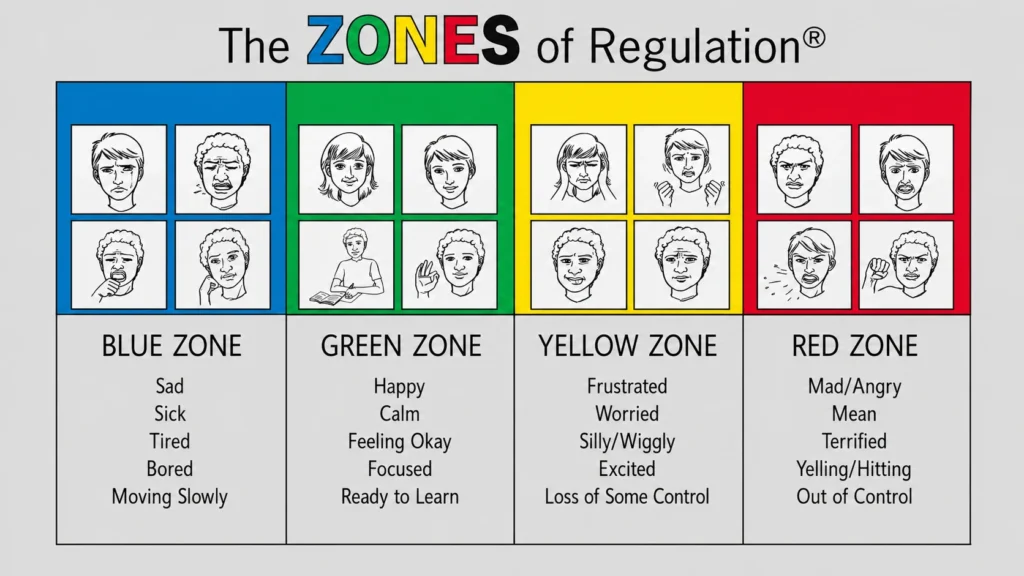
The Red Zone is used to describe extremely heightened states of alertness and intense emotions. A person may be elated or experiencing anger, rage, explosive behaviour, devastation, or terror when in the Red Zone.
The Yellow Zone is also used to describe a heightened state of alertness and elevated emotions, however one has more control when they are in the Yellow Zone. A person may be experiencing stress, frustration, anxiety, excitement, silliness, the wiggles, or nervousness when in the Yellow Zone.
The Green Zone is used to describe a calm state of alertness. A person may be described as happy, focused, content, or ready to learn when in the Green Zone. This is the zone where optimal learning occurs.
The Blue Zone is used to describe low states of alertness and down feelings such as when one feels sad, tired, sick, or bored.
This program was designed by Leah Kuypers, M. A. ED., OTR/L an occupational therapist and autism resource specialist. More information is available on the website https://www.zonesofregulation.com